The labia majora is a part of the vulva (the external portion of the female genital organs) and includes the two outermost folds of skin. The skin over the labia majora contains hair and surrounds the clitoris, urethra, and vaginal opening.
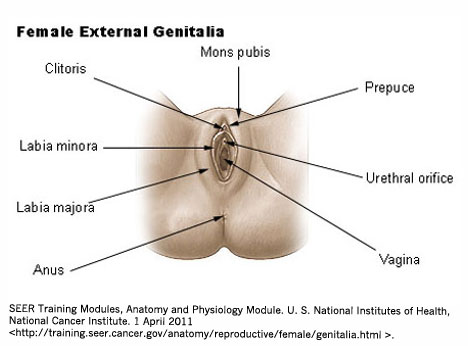
The labia minora is a part of the vulva (the external portion of the female genital organs) and includes the two innermost folds of skin between the labia majora. The skin over the labia minora does not contain hair and surrounds the clitoris, urethra, and vaginal opening.
Lactation is the process of milk secretion that occurs in female mammals in order to provide nourishment and immune protection for offspring. Lactation is dictated by the production and release of specific hormones designed to develop the ductal system of the breasts, which begins around the second trimester of pregnancy.
Lactotropes are specialized cells in the anterior pituitary gland that produce the hormone prolactin.
Lanugo is a soft downy hair that grows on the fetus as a normal part of gestation. Lanugo appears by about the fifth month of gestation and is shed at around 33-36 weeks of gestational age. Although lanugo can be seen on the shoulders of a newborn, more extensive presence on a newborn is a sign of premature birth. Most lanugo still present on newborns, commonly referred to as “peach fuzz,” is shed within a couple weeks after birth.
Laparoscopy is a key-hole surgical procedure that allows surgeons to see inside the abdomen. This type of surgery is very useful for viewing the female reproductive organs (uterus, ovaries, etc.). It normally requires a general anesthetic, but patients can often go home the same day as surgery.

Also known as Gregor Mendel’s third law, this law states that one allele is always dominant over the other and is expressed, unless both alleles are recessive, and therefore, both expressed.
Also known as Gregor Mendel’s second law, this law states that any given two traits are inherited independently of one another, and the probability that they are both inherited is left to chance.
Also known as Gregor Mendel’s first law, this law states that during the production of gametes, genes are separated, so that the offspring will inherit one from each parent.
A non-steroidal aromatase inhibitor. As this drug reduces estrogen production, it may be used to induce ovulation, and in the treatment of estrogen-sensitive of breast cancer.
Leydig cells are cells within the male testes that produce the hormone testosterone in response to the release of luteinizing hormone (LH) from the pituitary gland. Leydig cells are found within the interstitial space of the testes between the seminiferous tubules.
The LH surge occurs at the halfway point of the menstrual cycle (usually between days 12 and 16) and induces ovulation and formation of the corpus luteum. It is accompanied by a smaller FSH surge. A woman trying to conceive can use a kit to detect the point of the LH surge, where 24-36 hours after a positive result is usually the optimal time for intercourse.
Libido is a term for sexual desire or the degree of sexual appetite and is the psychological and emotional energy attached to one’s sex drive. Low libido is associated with a decreased desire to have sexual intercourse.
The limbic system is comprised of a set of structures located in the brain involved in the control of emotion, behavior, and memory.
Lobular is a term used to describe lobules or glands found in breast tissue that produce milk. Lobular is a descriptor of abnormal breast cell growth that begins in the lobules, e.g. lobular carcinoma and lobular neoplasia.
The luteal phase is the portion of the menstrual cycle in which the corpus luteum forms and matures. This half of the menstrual cycle begins with ovulation and ends when menstruation begins. The luteal phase is characterized by a gradual rise in the steroid hormone progesterone.

Luteinization is the set of processes by which differentiation of the theca cells and granulosa cells of the post-ovulatory ovarian follicle results in the formation of a corpus luteum.
Luteinizing hormone (LH) is a hormone released by the pituitary gland that regulates a female’s menstrual cycle and ovulation. LH also plays an important role in a male’s sperm production, as it stimulates the production of male sex hormones.